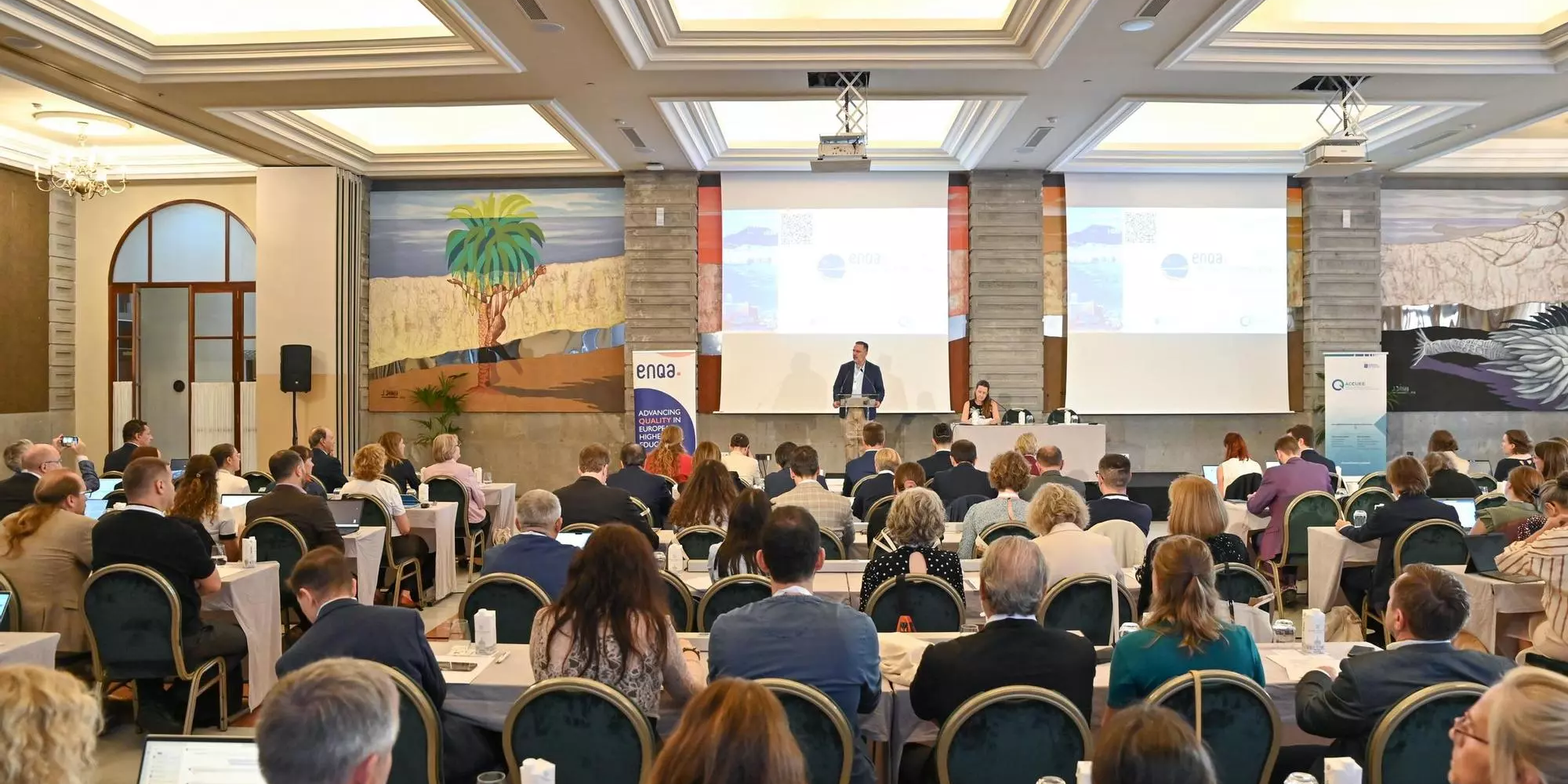
The Valencian Agency for Assessment and Foresight (AVAP) attended the 2026 General Assembly of the European Association for Quality Assurance in Higher Education (ENQA), held from 21 to 23 October at the Hotel Santa Catalina in Las Palmas de Gran Canaria. Bringing together more than 150 representatives from European quality assurance agencies and organisations, the event focused on the main challenges facing quality assurance in higher education and the importance of international cooperation in driving continuous improvement.
AVAP was represented by Javier Oliver Villarroya, Director General of the Agency, and Luis Miguel Martínez, from the Higher Education Quality and Innovation Service. They joined senior representatives and professionals from across Europe working in higher education evaluation and quality assurance.
Organised by ENQA and hosted by the Canarian Agency for Quality Assessment and Accreditation (ACCUEE), the General Assembly brought European experts together in the Canary Islands to exchange experiences, explore shared challenges and discuss initiatives aimed at strengthening the European Higher Education Area (EHEA).
The Canary Islands host the ENQA General Assembly for the first time
Hosting this year’s General Assembly marks an important milestone for the Canary Islands’ higher education sector. It is the first time the archipelago has welcomed the event and only the third time it has been held in Spain, following previous editions in Córdoba in 2015 and Zaragoza in 2018.
The official opening, held on Thursday 22 October, featured Cristina Ghițulică, President of ENQA; María Rosa Suárez Vega, Director of ACCUEE; and Poli Suárez, Regional Minister for Education, Vocational Training, Physical Activity and Sports of the Government of the Canary Islands.
In his opening remarks, Poli Suárez highlighted the significance of hosting an event of this kind for the first time and the valuable opportunities it provides to exchange experiences with Europe’s leading quality assurance agencies.
He also emphasised that educational evaluation must make a tangible contribution to improving teaching and learning, providing reliable evidence to identify strengths, address areas for improvement and inform decision-making across educational institutions.
María Rosa Suárez Vega, meanwhile, underlined the importance of the General Assembly as an opportunity to strengthen the Canary Islands’ involvement in the European Higher Education Area and contribute to international discussions on the future of quality assurance in higher education.
Collaborate. Learn. Innovate.: the central themes of the 2026 General Assembly
Under the theme “Collaborate. Learn. Innovate.”, this year’s General Assembly placed cooperation at the heart of efforts to encourage innovation and continuous improvement in higher education.
Throughout the event, participants explored different aspects of collaboration, from relationships between quality assurance agencies and universities to transnational cooperation, involvement in education policy development and the exchange of knowledge and good practice.
A central aim of the discussions was to consider how quality assurance agencies can work more closely with higher education institutions and other stakeholders while safeguarding the independence, transparency and rigour of evaluation processes.
These issues are particularly relevant as European higher education systems respond to emerging challenges linked to internationalisation, sustainability and changing approaches to teaching and learning.
Collaboration between quality assurance agencies and universities takes centre stage
The first plenary session, held on Thursday 22 October, focused on collaboration in higher education and the relationship between quality assurance agencies and universities.
Speakers included Riitta Pyykkö, Professor and former Vice-Rector of the University of Turku (Finland), and Esther Huertas Hidalgo, Head of the Quality Assessment Department at AQU Catalunya. The session was chaired by Kristin Vinje, Vice-President of ENQA.
Discussions explored opportunities for closer cooperation between internal and external quality assurance systems, as well as the need to strike an appropriate balance between accountability and continuous improvement.
Participants also considered the importance of preserving institutional autonomy and the independence of quality assurance agencies, preventing potential conflicts of interest and establishing effective, constructive relationships between both parties.
This debate reflects one of the core responsibilities of quality assurance agencies: helping to ensure that higher education programmes and qualifications meet recognised quality standards.
Transnational education and international cooperation
Another major focus of the General Assembly was quality assurance in transnational education, an area of growing importance for European higher education systems.
The second plenary session brought together representatives from ENQA and the Organisation for Economic Co-operation and Development (OECD), including Matej Bilik, Policy Analyst at the OECD; Elena Cirlan, Senior Policy and Project Coordinator at ENQA; and Alexis Fábregas Almirall, Project and Reviews Officer at ENQA.
The session examined progress made through ROQA-TNE, an ENQA-coordinated project exploring policies and practices relating to quality assurance in transnational education across the European Higher Education Area.
Transnational education presents new challenges for quality assurance agencies, particularly when it comes to ensuring the quality of programmes delivered across national borders and coordinating evaluation procedures between organisations in different countries.
Sharing experiences and developing stronger cooperation mechanisms can help establish more consistent approaches to evaluation, better suited to the increasingly international nature of higher education.
Sustainability, strategic communication and the revision of European quality standards
The final day of the General Assembly, Friday 23 October, featured a series of workshops and discussions exploring some of the key challenges facing the future of quality assurance in higher education.
One workshop focused on integrating sustainability into quality assurance systems, examining how agencies can support education for sustainable development through both their direct responsibilities and their wider influence on higher education institutions.
Another session addressed strategic communication by quality assurance agencies, with particular attention to the strategies and tools used to communicate their work effectively to universities, stakeholders and wider society. Transparency and communication were highlighted as essential elements in building trust in quality assurance processes.
The programme also included a session on the revision of the European Approach for Quality Assurance of Joint Programmes, providing an opportunity to review proposed changes and consider their potential implications for higher education institutions and quality assurance agencies.
The General Assembly also explored collaboration in European education policy development and the ongoing revision of the Standards and Guidelines for Quality Assurance in the European Higher Education Area (ESG).
The final plenary session featured Anna Gover, Director of ENQA, and Horia Onița, Head of the European Higher Education Area Secretariat, and was chaired by Cristina Ghițulică, President of ENQA.
Discussions centred on the revision of European quality standards, the approval process and the priorities of the Bologna Process for the coming years. These are key considerations in developing more closely aligned higher education systems built around shared quality principles.
ACCUEE’s role in the European quality assurance framework
Hosting the General Assembly also provided an opportunity to recognise the work and achievements of the Canarian Agency for Quality Assessment and Accreditation (ACCUEE), which became a full member of ENQA in April 2023 following a successful international external review.
This recognition also enabled ACCUEE to join the European Quality Assurance Register for Higher Education (EQAR), strengthening its position within the European quality assurance and accreditation framework.
In 2027, ACCUEE is due to undergo a further external review and seek renewal of its registration with EQAR, as part of the periodic processes established to ensure continued compliance with international quality standards.
Hosting the event in the Canary Islands has helped raise the profile of the agency’s work and strengthen relationships between the organisations involved in improving higher education quality across Europe.
AVAP strengthens its involvement in European quality assurance initiatives
The participation of Javier Oliver Villarroya and Luis Miguel Martínez in the ENQA General Assembly 2026 reflects AVAP’s continued involvement in European cooperation and knowledge-sharing initiatives focused on evaluation and quality assurance in higher education.
Attending events of this kind provides valuable opportunities to learn from the experiences of other European agencies, exchange perspectives on shared challenges and keep pace with developments in international evaluation procedures and quality standards.
It also helps strengthen institutional relationships and maintain an up-to-date understanding of the initiatives shaping the European Higher Education Area.
Through its participation, AVAP reaffirms its commitment to international cooperation, the continuous improvement of evaluation processes and the advancement of quality in higher education, contributing to the discussions and collaborative initiatives that will help shape the future of European higher education.