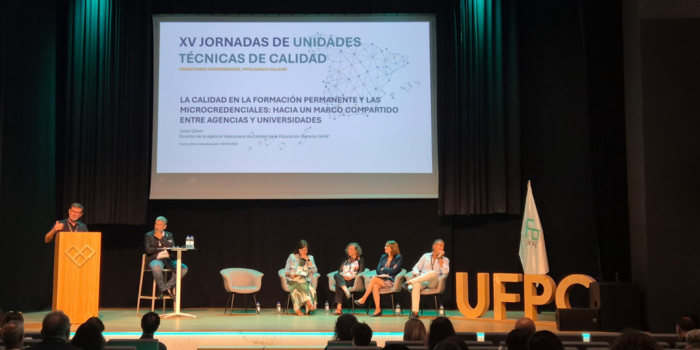
On 1 and 2 October, Universidad Fernando Pessoa Canarias hosted the 15th Conference of the Technical Quality Units of Spanish Universities at its Santa María de Guía campus in Gran Canaria. The event brought together professionals from universities, quality assurance agencies and technical quality units from across Spain.
Over the two days, the programme addressed some of the main challenges currently facing the university system in relation to evaluation, quality assurance and continuous improvement. The evolution of internal quality assurance systems, the role of technical quality units, European university alliances, lifelong learning, micro-credentials, institutional accreditation and teaching enhancement were among the key themes discussed.
Lifelong learning and micro-credentials: towards a shared framework
AVAP took part in the session “Quality, lifelong learning and micro-credentials: building a shared vision”, held on the afternoon of 1 October.
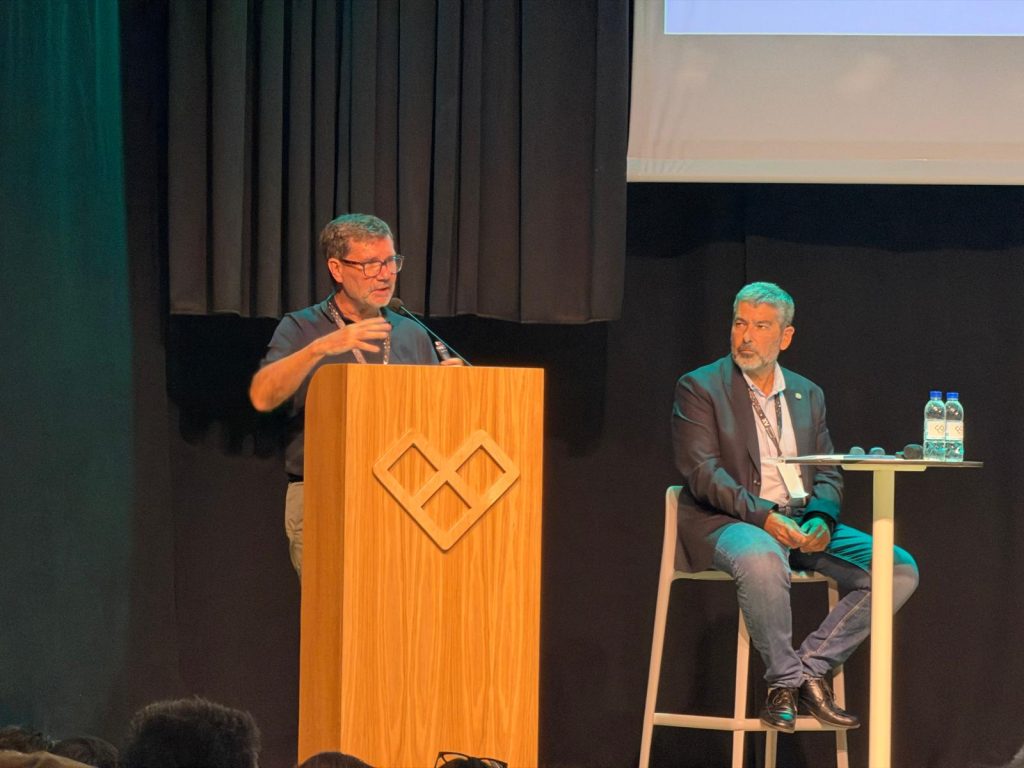
Francisco Javier Oliver Villarroya, Director General of AVAP, opened the session with the presentation “Quality in lifelong learning and micro-credentials: towards a shared framework between agencies and universities”.
His contribution focused on one of the main challenges posed by these new forms of learning: how to ensure their quality through criteria suited to their specific characteristics, without simply applying the same procedures used for official university degrees.
Lifelong learning and micro-credentials respond to a different reality, one defined by greater flexibility, new formats and a closer connection with lifelong learning needs and the changing demands of the professional environment.
In this context, moving towards common reference points between agencies and universities is essential to strengthen quality, transparency and trust in these forms of provision.
The experience of four Valencian universities
Following Javier Oliver’s contribution, the discussion continued with perspectives from four Valencian universities and their quality units.
Participants included Inmaculada Doménech Martínez, Quality Officer in the Strategic Development and Quality Unit at Universidad CEU Cardenal Herrera; Amparo Chirivella Ramón, Head of the Quality Section at Universitat de València; David León Espí, Director of the Quality Service at Universidad Miguel Hernández; and María Carmen Albert Guardiola, Director of the Technical Quality Unit at Universidad de Alicante.
Their contributions brought the debate closer to the day-to-day reality of universities and offered first-hand insight into how lifelong learning and micro-credentials are being approached from an internal quality management perspective.
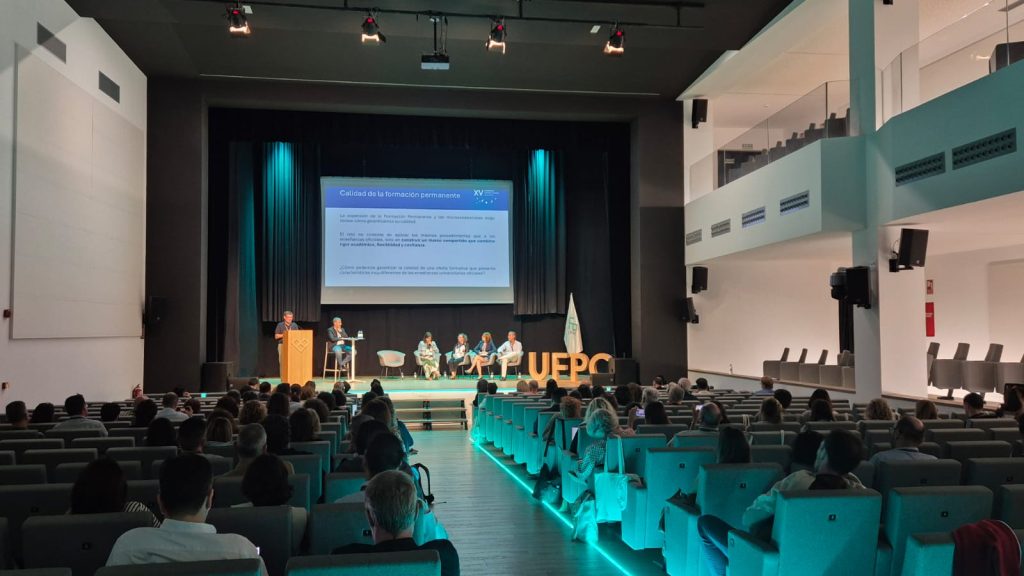
Over the course of almost an hour and a half, the agency perspective was combined with direct university experience, allowing participants to share challenges, approaches and working methods. The session concluded with questions from the audience and an exchange of experiences among attendees.
The session was moderated by Luis Hernández Calvento, Vice-Rector for Degree Programmes, Quality and Educational Innovation at Universidad de Las Palmas de Gran Canaria.
The role of Technical Quality Units
One of the central themes of the Conference was the evolving role of Technical Quality Units within universities.
The programme explored how these units have progressively broadened their remit, moving beyond a primary focus on evaluation and monitoring processes to take on an increasingly cross-cutting role in institutional improvement and transformation.
In this context, participants discussed the evolution of Internal Quality Assurance Systems (IQAS) and their potential to become not only management tools, but also instruments for decision-making, transparency, accountability and continuous improvement.
Other issues included leadership, available resources, staff development and the need to strengthen alliances within universities themselves.
European university alliances and new quality challenges
Another session on the first day focused on European university alliances and the new challenges they create for quality assurance.
The presentations explored issues related to joint degrees, coordination between institutions in different countries and the need to develop evaluation and management models capable of responding to increasingly integrated university structures.
The topic was addressed from several perspectives: those of the alliances themselves, quality assurance agencies and the technical units responsible for translating these processes into academic management.
Institutional accreditation and teaching enhancement
The second day, held on 2 October, focused in particular on institutional accreditation and its renewal.
A series of presentations shared experiences related to the evolution of accreditation procedures, document management, evidence control and the role of internal quality systems in strengthening the institutional development of university centres.
The programme also examined the involvement of Technical Quality Units in teaching enhancement policies, reinforcing a view of university quality that is increasingly connected with the overall functioning of institutions.
Two days to share experiences and advance university quality
The 15th Conference was hosted jointly by Universidad Fernando Pessoa Canarias, Universidad de La Laguna, Universidad de Las Palmas de Gran Canaria and Universidad del Atlántico Medio, with the collaboration of the Canary Islands Agency for University Quality and Educational Evaluation.
The event provided an opportunity to share experiences, compare approaches and create new spaces for collaboration between universities, technical units and quality assurance agencies.
AVAP’s participation in this type of forum helps strengthen knowledge exchange and supports the development of shared responses to the new challenges facing higher education.
Lifelong learning, micro-credentials, institutional accreditation, European alliances and the evolution of quality systems are all part of the same conversation: how to continue ensuring and improving university quality in a constantly changing environment.