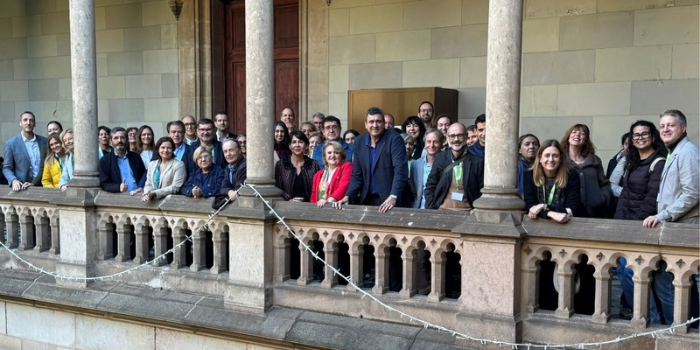
From 2 to 4 November 2026, Barcelona hosted the 2nd Technical Conference of the Spanish Network of University Quality Agencies (REACU), organised by AQU Catalunya. The event brought together representatives and technical staff from university quality assurance agencies to share experiences, explore the key challenges facing higher education and strengthen cooperation between quality assurance bodies.
Held at the Faculty of Geography and History and the Historic Building of the University of Barcelona, the three-day conference covered a wide range of topics, including artificial intelligence in evaluation processes, institutional accreditation, emerging European developments, double degrees, micro-credentials and academic staff accreditation.
AVAP was represented at the conference by Francisco Javier Oliver Villarroya, Director General; Reyes Giner Escrihuela, Head of the Higher Education Quality Service; and Inma March, responsible for the verification and modification of titles.
Javier Oliver played a prominent role throughout the conference, chairing two plenary sessions and contributing to a technical workshop alongside Reyes Giner.
Strengthening cooperation between university quality assurance agencies
The conference opened on Monday 2 November with an institutional welcome from Miquel Soriano, Director General for Universities; Mercè Gisbert Cervera, Director of AQU Catalunya; and Miguel Aguilar Urbano, Director of ACCUA and REACU Coordinator.
The opening plenary focused on the challenges facing quality assurance in Spanish higher education, particularly the need to streamline evaluation procedures, reduce unnecessary bureaucracy and foster a genuine culture of quality within universities.
The discussion was chaired by Federico Morán Abad, Director of Fundación para el Conocimiento madri+d, and featured contributions from Pilar Paneque Salgado, Director of ANECA, and Mercè Gisbert.
The first day also included a meeting of agency directors, providing an opportunity to strengthen coordination and exchange experiences among REACU member organisations.
Indeed, one of the conference’s main objectives was to build stronger connections between technical teams, encourage the sharing of good practice and promote joint approaches to the challenges facing quality assurance across the university sector.
Artificial intelligence, accreditation and emerging European challenges
The second day opened with a plenary marking REACU’s twentieth anniversary and reflecting on how university evaluation processes have evolved over the past two decades.
Introduced by Mercè Gisbert, the session featured contributions from Francesc Xavier Grau, President of AQU Catalunya, and José Eduardo López Pereira, Director of ACSUG, who reviewed REACU’s development over its first twenty years.
A central theme of the conference was the use of artificial intelligence in external quality assurance processes, with particular attention given to legal and ethical considerations, intelligent academic verification tools and the development of auditable decision-making criteria in teaching evaluation.
The programme also explored emerging international developments, particularly the European Approach and the Joint European Degree Label, both relevant to quality assurance for international joint degree programmes. This plenary was chaired by Federico Recart Barañano, Director of Unibasq.
Another session focused on institutional accreditation, including approaches to evaluating internal quality assurance systems and opportunities to reduce the administrative burden of evaluation on universities. Chaired by Cristina Rodríguez Coarasa, Director of ACPUA, the discussion brought together experiences from different higher education systems, including a presentation by Isaac Galobardes of AQUA on the evolution of quality assurance in Andorra.
AVAP takes a leading role in discussions on official university qualifications
One of AVAP’s key contributions took place on Tuesday 3 November, when Javier Oliver Villarroya chaired Plenary Session 5: Quality Assurance of Official University Qualifications, with a particular focus on double degrees and micro-credentials.
The session featured contributions from Isabel Ortega Pardos of ACPUA, Aixa Noda of ACCUEE and Josep Manel Torres of AQU Catalunya, who presented a study on double degree programmes in Catalonia.
The discussion explored different aspects of quality assurance for these forms of study, which present new challenges for evaluation procedures and for the agencies responsible for safeguarding the quality of university provision.
AVAP’s involvement in this session reflects its commitment to exchanging expertise and addressing the evolving needs of the higher education sector.
AVAP contributes to technical working groups and the final conclusions
The final day, held on Wednesday 4 November at the Historic Building of the University of Barcelona, focused on academic staff accreditation and specialist technical workshops.
The programme included a plenary session on academic staff accreditation, followed by parallel workshops examining the evaluation of research activity for employment-related six-year assessment periods and the procedures governing the authorisation of new universities and centres.
Javier Oliver Villarroya and Reyes Giner Escrihuela, Head of AVAP’s Higher Education Quality Service, contributed to the preparation and facilitation of the second workshop alongside representatives from other agencies.
The session addressed the authorisation of new universities and affiliated centres, institutions offering programmes leading to foreign higher education qualifications, and centres delivering official university degrees outside their home territories.
Later that morning, Javier Oliver chaired the plenary session presenting the working groups’ conclusions, held in the Aula Magna of the Mathematics Cloister, where participants shared the main findings and contributions from the technical discussions.
The conference concluded with closing remarks from Mercè Gisbert, Director of AQU Catalunya, and Miguel Aguilar, Director of ACCUA and REACU Coordinator.
 Valencia to host the next REACU Technical Conference in 2027
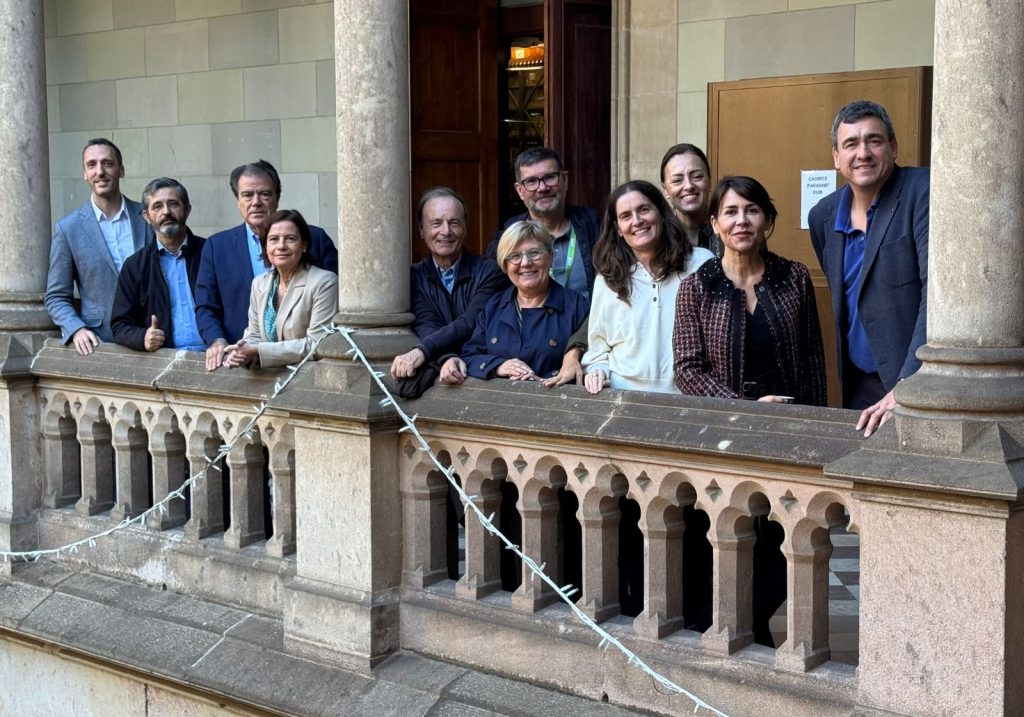
Following this year’s event in Barcelona, AVAP will take over responsibility for organising the next REACU Technical Conference, which will be held in Valencia in 2027.
The next edition will build on the work undertaken in Barcelona, providing another opportunity for agencies to strengthen cooperation, exchange expertise and develop shared approaches and procedures aimed at improving quality assurance processes.
By taking on this organisational responsibility, AVAP reaffirms its commitment to working closely with fellow university quality assurance agencies and promoting a culture of quality focused on the continuous improvement of higher education.